Within the rural and urban population dynamics modelled within LUCCIA, attractivity maps are used to allocate spatially the houselholds.
The general attractivity map is used for the settlement of rural households, which are the focus of the model. It results from the combination of different spatial factors :
- Road network to take into account accessibility of areas
- Cropland, grassland, miombo forest, and slope to take into account the crude amount of accessible land area
- Protected Areas to take into account the land tenure limitations
Urban population is modelled more simply as it was not the focus of LUCCIA. The urban attractivity map is used for the spatial allocation of urban population as an input to the urban module which includes urban sprawling. It also results from the combination of different spatial factors :
- Slope for suitability
- Road network for accesibility
- Protected Areas for land tenure limitations
Spatial crop yields time series were produced using an adapted custom version of the SARRA-O model developed by UMR TETIS from the CIRAD. It primarily uses data on cropping practices, main climate variables, and soil conditions.
The orignal spatial resolution of the output of the SARRA-O model is 25 km but it was resampled to 1 km to fit the LUCCIA model land unit size. A smoothing at the pixel level of the yield maps time series was also done to improve the data quality :
- Spatial smoothing : moving average with a circular window of 25 km
- Temporal smoothing : average of values for years N-1, N, and N+1
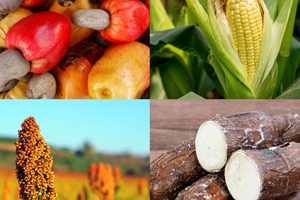
The productivity of 10 crops is predicted : Cassava, Maize, Feijao (Beans), Rice, Groundnut, Sorghum, Sesame, Cotton and Tobacco.
For each crop, a full time series of predicted yield maps spanning from 2017 to 2050 at national level with a spatial resolution of 1 km was done with two more combined factors :
- 4 levels or ranges of yield : increasing from level 1 to 4
- 2 IPCC climate scenarios used as input of the SARRA-O model for bioclimatic variables : SSP1-2.6 (optimistic) and SSP5-8.5 (pessimistic)
Hence for each crop, 272 maps were produced (34 years x 4 yield levels x 2 climate scenarios), and in total for all the crops 2720 maps. In this geoportal, only a subset of this dataset is presented as a showcase as it would not be possible to load all the maps.
Gathers various datasets and land tenure ranging from protected areas to mining licences. Data was collected from several minitries :
- ANAC - Administração Nacional das Áreas de Conservação : National Administration of Conservation Areas
- DINAF - Direcção Nacional de Florestas : National Forestry Directorate
- FNDS - Fundo Nacional de Desenvolvimento Sustentável : National Fund for Sustainable Development
- MIREME - Ministério dos Recursos Minerais e Energia : Ministry of Mineral Resources and Energy
Compilation of several datasets on Land Use / Land Cover and Land Use / Land Cover Change that have been produced in Mozambique by the FNDS or Nitidæ. Land use changes of mainly focused on deforestation. Data was also produced on fallow : prediction of fallow age based on cropland extent, vegetation height and a field model linking fallow age and vegetation height.
Two dataset used as input of the LUCCIA model are present :
- 2016 LULC map from the FNDS that was refined (spatial sieving and circular focal window filtering)
- 2019 fallow coefficient aggregated at 1 km² using the mean value. It is used to have spatial variability across Mozamboque in the fallow duration of the cultivated crops at the household level
Presents all suitability maps both for crop and tree species produced for input of the LUCCIA model. Not all species presented here were included eventually in the model (avocado for instance)
The maps were produced using Spatial Distribution Models (SDMs) with only occurence points of crops and trees mainly extracted from the 2015 IAS national survey on households coupled with biophysical explanatory variable. Ensemble modelling with 9 differents methods was used (Maximum Entropy or Central Neural Network for instance).
Maps were also classified from quantitative to qualitative indication of the suitability. In total, suitatibilty maps for 9 crops species and 9 tree species were produced. Suitability maps from LUCCIA Phase 1 (called LAUREL/LANDSIM) were also included in this geoportal in order to be able to compare the improvement.
Projet d'Appui aux Systèmes Sylvicole et Agroalimentaire Durable
Illustration
Title
Projet d'Appui aux Systèmes Sylvicole et Agroalimentaire Durable
Abstract
Appui à la création de l’Observatoire des prix du bois du MINEF
Collecte et analyse des prix du bois sur pied et des prix du bois sur les marchés (national et international).
Mise à disposition des parties prenantes des données sur le prix du bois sur pied et sur l’évolution des prix du bois sur les marchés (national et international).
Identification et accompagnement de 15 exploitant(e)s forestier(e)s tel que défini par le Code Forestier
Sélection de 5 exploitants par région, déjà en activité ou non (au moins 50% de femmes si possible)
Appui à la formalisation (le cas échéant).
Formation ad-hoc (mêmes principes que la formation dédiée aux sylviculteurs).
Équipement : lots de matériel pouvant être composés de scies passe-partout, fendeuses, tronçonneuses, petits engins de transport (micro-débardeurs, tricycles) ainsi que d’évents et cheminées pour les charbonniers.
Appui à l’exploitation et commercialisation des bois issus des forêts sous DGD (450 propriétaires visés)
Ce projet contient l'ensemble des données géographiques du géoportail du Conseil Regional du Tchologo. Il a été mis en place par l'ONG Nitidae dans le cadre du projet PAPBIO Comoé. C'est un outil de gouvernance et de gestion transparente innovante du territoire en s'appuyant sur les capacités d'organisation, de gestion, d'analyse et de présentation d'un Système d'Informations Géographique.